
Rule of Thumb First
If your garage door is hard to move on a chilly morning, the temperature itself is rarely the real problem—moisture almost always got there first. Cape Canaveral doesn't see hard freezes, but the cold fronts that roll through from late fall into winter can drop temperatures fast right after humid, dewy nights, and that swing is what trips people up.
The exceptions: a rare frost advisory morning after a clear, calm night can leave a thin layer of condensation that stiffens rubber seals and thickens lubricant just enough to notice. And any door that spent hurricane season soaking up salt air and humidity is already primed to react badly the first time it gets genuinely cold.
Symptoms You'll Notice First
- The door feels glued to the ground. You hit the opener and it strains, stalls, or trips the safety reverse before the door lifts.
- Grinding or scraping instead of a smooth roll. Usually loudest in the first few feet of travel.
- The opener motor runs but the door barely moves. You'll hear the unit working hard with little result.
- A shudder or jerk partway up, as if something is catching and releasing.
- The bottom seal looks stuck to the slab, especially on a garage floor that stayed damp overnight.
Causes, in the Order a Technician Checks Them
1. The Weatherstrip Seal Stuck to the Concrete
This is the first thing worth ruling out because it's the simplest. Overnight condensation can let the rubber bottom seal tack itself lightly to the slab. A tech will check for this visually, then gently break the seal free rather than let the opener force it—forcing it strains the bottom panel and the opener's drive system. The fix is usually just a firmer manual lift to break contact, followed by a check that the seal isn't cracked or swollen enough to keep doing this.
2. Debris or Corrosion in the Tracks
Next is the track itself. Salt air near the coast speeds up surface rust on steel tracks, and sand or grit from storms can settle into the track channel. A tech runs a hand along both tracks checking for pitting, rust flakes, or buildup, then cleans the channel and checks that the tracks are still plumb and properly spaced—cold doesn't bend metal, but a track that was already slightly out of alignment will bind worse when everything else stiffens up.
3. Dry or Thickened Lubricant on Rollers and Hinges
Lubricant behaves differently once temperatures drop, and if it's old or the wrong type (household oils and WD-40 aren't garage door lubricant), it can gum up rather than glide. A technician checks each roller and hinge by hand for resistance, then applies a silicone-based garage door lubricant—not grease, which attracts grit, especially bad near the coast where salt and sand are already in the air.
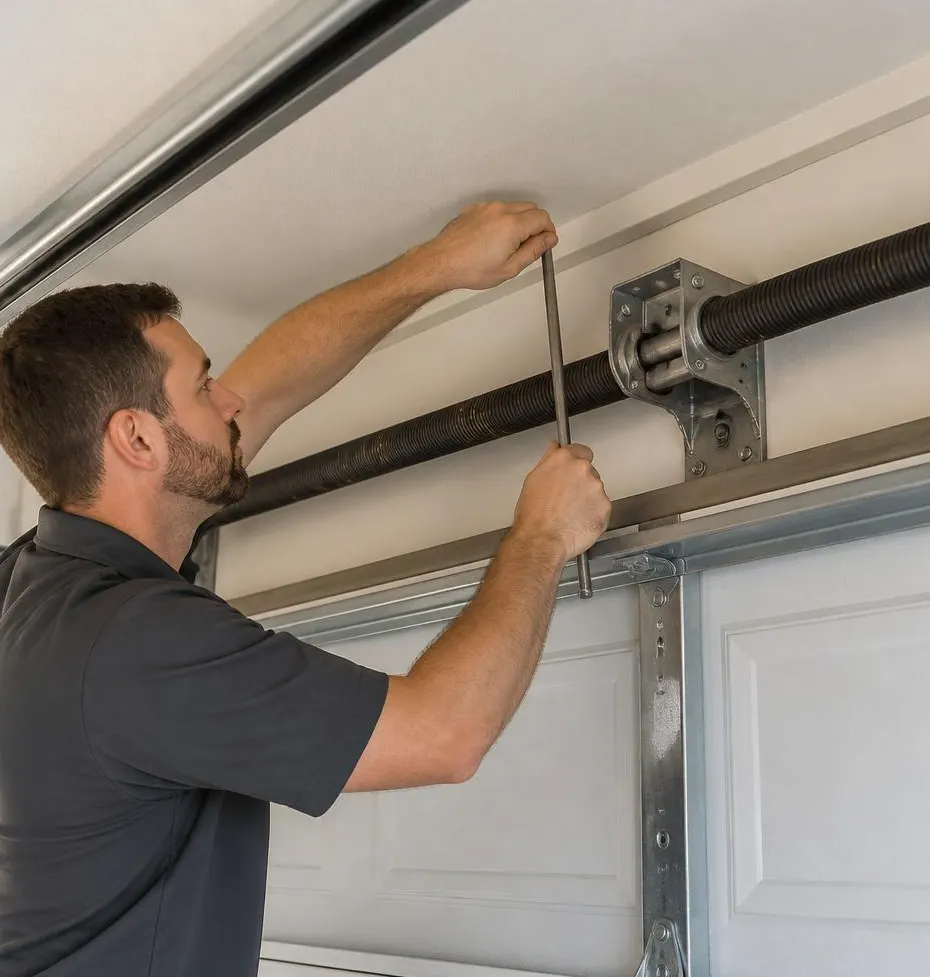
4. Spring Tension and Balance
Springs are checked next because a door that's merely stiff feels very different from a door that's actually out of balance. A technician disconnects the opener and manually lifts the door partway to see if it holds its position. If it drops or shoots up, the spring tension has shifted—sometimes from age, sometimes from the metal contracting slightly in a cold snap. Spring replacement is a job for a professional; the springs are under heavy tension and improperly adjusting them is a real safety risk.
5. Opener Settings: Force and Limit
If the door still struggles after the above, the opener itself gets checked. Cold can make the door's resistance increase just enough to trip the opener's force setting or throw off the travel limits, especially on units that haven't been serviced in a while. A technician will test the force and limit settings and recalibrate them to match the door's actual, current resistance—not just crank up the power, which can mask a real mechanical problem.
6. Panel Swelling, Especially on Wood or Wood-Composite Doors
Last on the list because it's the slowest-developing cause: humidity swells wood and wood-composite panels over the course of the wet season, and a sudden cold, dry snap can cause uneven shrinkage that leaves panels binding against the frame or each other. This shows up as localized sticking rather than whole-door resistance, and the fix usually involves sanding, resealing, or in persistent cases, replacing the affected panel.
When to Call Cape Canaveral Garage Door
If breaking the seal loose and a quick wipe-down doesn't solve it, or if the door feels unbalanced when you lift it manually, stop operating it with the opener. That's a sign of spring wear, which our Spring Replacement service handles safely with the right tools and tension gauges. For doors that are generally sluggish, noisy, or have gone a year or more without attention, our Garage Door Maintenance service covers lubrication, track alignment, hardware tightening, and opener calibration in one visit—exactly the kind of tune-up that keeps a coastal door running smoothly through the temperature swings ahead.
If your garage door is sticking, groaning, or just not acting right this season, call Cape Canaveral Garage Door and we'll get it moving the way it should, all across the Space Coast.